Perspective
I don’t want AI writing stories either. But assistive AI can help literary agents in this narrow, administrative way
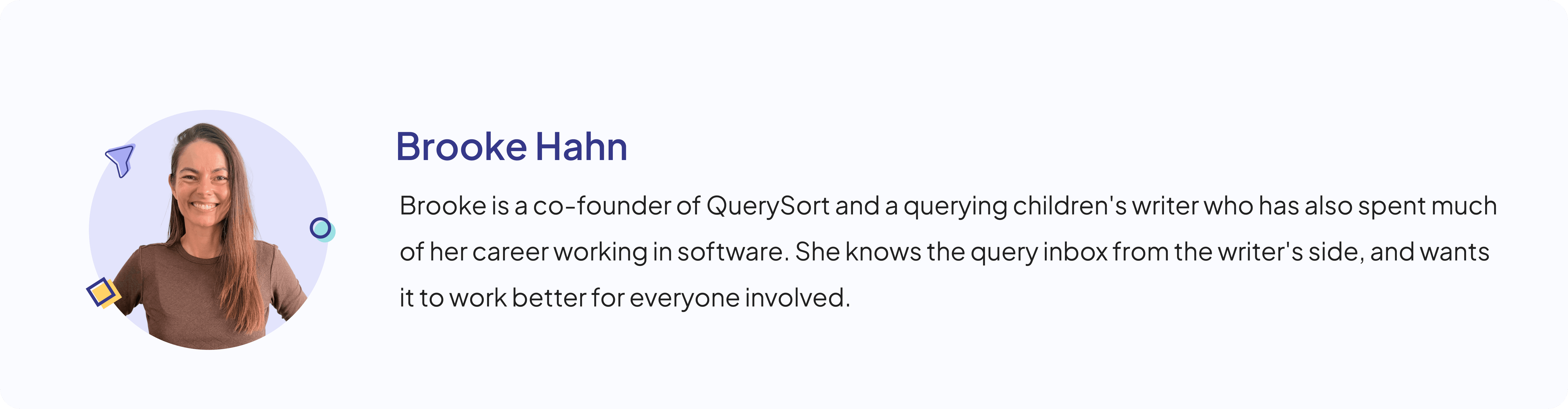
Brooke's take on AI in publishing: where it doesn’t belong, and the one place it can help literary agents.

I’m straddling two worlds with very opposing views on AI.
In the software world, almost every tool has been rebranded to include AI in its tagline. Monday.com is for humans and agents for productivity, Miro is the collaborative AI workspace. Figma is the AI design workspace.
In the tech industry, if you don’t have AI as a significant part of your software tooling, you’ll be left behind or perceived as outdated. Just before I left my former job as Head of Marketing in a software company, we’d just released an AI agent to help customers use our product more efficiently. I was given the lead to reposition the company as, yep, you guessed it, the geospatial AI workspace.
AI is everywhere in software.
And I’ve used it every day in my working life, not only because we were mandated to, but also because the efficiency it provides my existing daily workflows is unparalleled.
Creative work belongs to humans
But then there is me, the writer. I am fiercely protective of creative work belonging to humans. Any decisions about creative work – such as those by literary agents and publishers – belong to humans. Because readers want to connect to a human’s story.
That creative process, to create something from nothing, to write characters that feel completely real and relatable yet are entirely made up by the writer, that is a form of magic. When I read a particularly relatable piece in a story, I sit for a few moments in awe of the author. How did they capture that personality trait, that flawed logic, that so very human way of being, so perfectly?
I’m currently reading Liane Moriarty’s Apple’s Never Fall and it is utterly brilliant. The pacing, the structure to the narrative, how the author is letting the story unfold in a way that sparks the most curiosity and intrigue… But what stops me in my tracks frequently – making me gasp or laugh out loud – are each character’s idiosyncrasies. They are complex, human characters, created by an author who deeply understands the human experience in all its layers and flaws. A form of magic.
And something I am fiercely eager to protect.
Because stories are inherently human.
They are something generative AI can never replace. Not because it can’t write incredibly well. It can. But because AI can never create that magic relationship between an author, their characters, and the reader.
AI can never replace human creation, because it is us humans that delight in experiencing human creation.
Do I want to listen to music created by AI? Absolutely not. Because songs aren’t just a good beat paired with two verses, a chorus and a bridge. Music is an artist processing life. That’s what I want to listen to.
But there are very specific use cases where bounded, assistive AI can support the processes around human-created stories. AI can support in managing overwhelming inboxes literary agents face in their endeavor to find the human stories they want to represent, and the human stories us readers want to read.
This is how QuerySort uses AI.

How QuerySort uses AI
QuerySort helps literary agents find the queries in their inbox that are a fit for their wishlist faster, by comparing the agents’ wishlist with the query a writer submits.
It’s comparing language with language. Simple keyword matching isn’t enough, because language is complex. A writer may describe their story with different words to those the agent uses in their wishlist, but the meaning is the same.
An agent looking for young adult stories set around a unique passion, and a writer’s query stating their story is about competitive rowing – keyword matching would not align these, yet QuerySort can.
No manuscripts are read.
No queries are stored on our system.
The query itself is processed once to complete the sorting, and then the data is deleted from our system.
We deliberately and specifically set these as our product boundaries. Because like the rest of the publishing industry, we care deeply about keeping stories 100% created by humans and literary judgement 100% in the hands of literary agents.
But we do believe tools like QuerySort can help remove the administrative overwhelm of human agents finding the human-written stories they want to champion.
––
You can find out more about our AI and product boundaries here, or feel free to contact us.